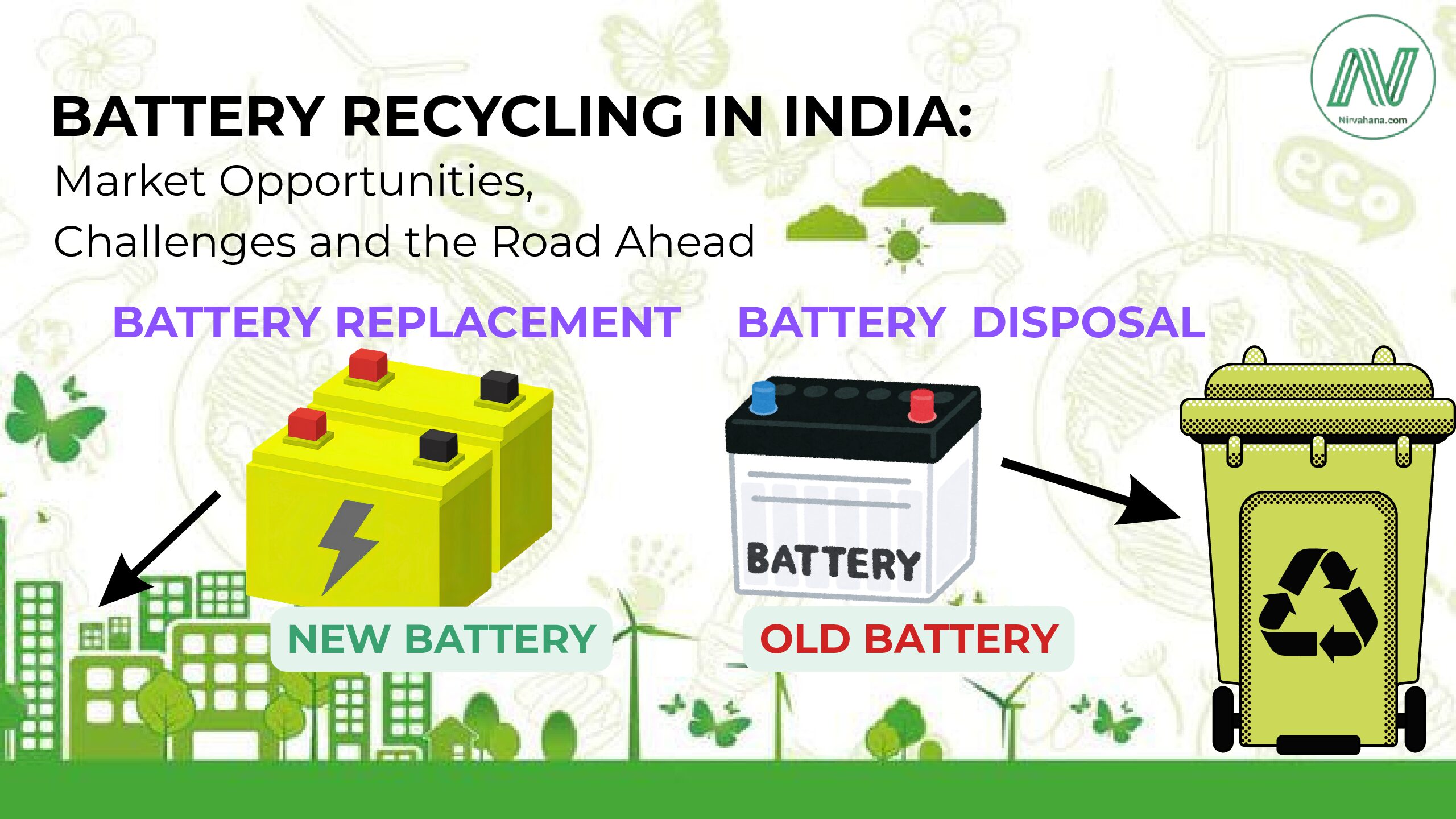
1. Introduction: Why Battery Recycling Matters for India’s Clean-Energy Future
India’s transition towards electric mobility, renewable energy and energy storage is creating new opportunities for businesses across the clean-energy value chain. Electric vehicles (EVs), solar energy storage systems, consumer electronics and industrial equipment increasingly depend on batteries to store and deliver electricity.
However, every battery eventually reaches the end of its useful life. If it is discarded without appropriate treatment, it can create fire risks, expose people and the environment to hazardous substances, and waste valuable materials that could otherwise be recovered.
This makes battery recycling in India an important part of the country’s clean-energy and resource-security strategy. Recycling can recover useful materials from discarded batteries, reduce dependence on newly mined resources and support domestic manufacturing. It can also create opportunities for recycling companies, technology providers, investors and businesses seeking more responsible waste-management practices.
India has already introduced a regulatory framework for battery waste management. The Battery Waste Management Rules, 2022, establish Extended Producer Responsibility (EPR), under which battery producers are responsible for meeting specified waste-management obligations. The government has also introduced financial incentives to encourage domestic critical-mineral recycling.
Nevertheless, a viable battery recycling industry requires more than regulations and investment. Reliable collection networks, safe handling, suitable recycling technologies, commercially attractive recovery processes and transparent material tracking are equally important. This article examines the opportunities, challenges and practical steps that can help India develop a more efficient and sustainable battery recycling ecosystem.
2. Understanding Battery Recycling and Its Role in India
Battery recycling is the process of collecting used batteries, making them safe to handle, separating their components and recovering materials that can be reused in manufacturing.
Different batteries require different recycling methods. Lead-acid batteries, commonly used in vehicles and backup power systems, have an established recycling pathway. Lithium-ion batteries, widely used in electric vehicles, smartphones and energy storage systems, require more specialised handling and processing.
How does lithium-ion battery recycling work?
Collection and transportation: Used batteries are collected from manufacturers, vehicle service centres, fleet operators, electronic equipment suppliers and other authorised sources.
Safety assessment and discharge: Batteries are inspected for damage, electrical hazards and fire risks. Appropriate procedures are followed before further processing.
Dismantling and separation: Battery packs are dismantled, and their components are separated using suitable mechanical processes.
Material recovery: Processes such as hydrometallurgy, which uses chemical solutions, and pyrometallurgy, which uses high temperatures, can recover valuable materials. Some processes also recover materials from an intermediate product known as black mass, a mixture of battery electrode materials.
Refining and reuse: Recovered materials are processed to meet the quality requirements of potential industrial buyers and battery manufacturers.
Not every recycling facility performs every stage. Some specialise in collection or mechanical processing, while others undertake chemical extraction and refining.
The commercial value of recycling depends on battery chemistry, material recovery rates, processing costs, safety requirements and the quality of recovered products.
Why is battery recycling important for India?
Resource security: Recovery of lithium, nickel, cobalt, copper and other useful materials can supplement supplies from mining and imports.
Domestic manufacturing: Recovered materials can support battery production and other industrial applications when they meet the required specifications.
Environmental management: Responsible recycling reduces the risk of inappropriate disposal and can reduce demand for some newly mined materials.
Industrial development: Collection, transportation, processing, testing and material refining can create business opportunities and specialised employment.
Circular economy: A circular economy keeps products and materials in productive use for longer instead of treating them as disposable resources.
The International Energy Agency (IEA) identifies recycling as an important contributor to future critical-mineral supply security, while emphasising that its benefits depend on effective collection and the availability of suitable recycling feedstock.
3. Market Opportunities for Battery Recycling in India
India’s battery recycling opportunity is developing alongside electric mobility, battery manufacturing and energy storage. However, investors must distinguish between long-term market potential and the quantity of batteries currently available for recycling.
3.1 Growth in electric vehicles and battery demand
Electric two-wheelers, three-wheelers, passenger vehicles and commercial fleets are expanding the market for rechargeable batteries. Battery manufacturing also generates production scrap that can enter suitable recycling streams.
The Ministry of Heavy Industries reported in December 2025 that, according to a NITI Aayog report published in May 2022, India’s annual lithium-ion battery demand was projected to reach approximately 210 GWh by 2030, compared with 40 GWh in 2025. These are projections cited by the ministry, not verified actual demand figures for those years.
For recyclers, growing battery deployment creates a future supply of end-of-life materials. However, many EV batteries remain in service for years, so increased battery sales do not immediately translate into equivalent quantities of recyclable waste.
In the near term, manufacturing scrap, damaged batteries and batteries retired from certain applications may provide important feedstock.
3.2 Government incentives and regulatory support
India’s policy framework is creating opportunities for formal recycling businesses.
The Battery Waste Management Rules, 2022, introduced Extended Producer Responsibility (EPR). Under this system, producers, including relevant manufacturers and importers, must meet applicable collection, recycling or refurbishment obligations through the prescribed framework.
In October 2025, the Ministry of Mines notified an incentive scheme for critical-mineral recycling with a total outlay of ₹1,500 crore. On 30 April 2026, the ministry announced that 58 entities had been approved as eligible for participation. Their combined pledged capacity was approximately 850 kilotonnes per annum, with pledged investments of around ₹5,000 crore across eligible recycling and other waste-processing segments. These figures represent pledged capacity and investment, not completed facilities or operational output.
This creates potential opportunities for businesses developing suitable material-recovery capabilities. Eligibility for financial support and actual disbursement remain subject to the scheme’s applicable conditions and implementation process.
3.3 Recovery of critical minerals
Lithium-ion batteries contain materials that may retain economic value after the battery stops being useful.
Lithium for potential reuse in battery-related supply chains.
Nickel and cobalt from chemistries that contain these metals.
Copper and aluminium from current collectors and other components.
Graphite and other materials where technically and commercially feasible.
The value proposition differs significantly between battery chemistries. Batteries based on lithium iron phosphate (LFP), for example, do not contain the nickel and cobalt found in nickel-based chemistries. Their recycling economics may therefore depend more heavily on lithium recovery, processing efficiency, regulatory incentives and service-based business models.
3.4 New business models across the value chain
The industry offers opportunities beyond operating a large recycling plant.
Battery collection and reverse logistics.
Safe storage and transportation services.
Battery testing and condition assessment.
Second-life battery applications where safety and performance requirements are met.
Recycling equipment, automation and process monitoring.
Material recovery, refining and quality testing.
Digital traceability and regulatory reporting.
Partnerships between battery producers, fleet operators and authorised recyclers.
For investors and entrepreneurs, the most suitable opportunity will depend on technical expertise, access to feedstock, capital availability and relationships with credible buyers.
4. Major Challenges Facing Battery Recycling in India
4.1 Inadequate collection and fragmented supply chains
A recycling facility needs a consistent supply of suitable batteries. However, end-of-life batteries can be distributed among households, workshops, dealers, fleet operators, manufacturers and informal collection networks.
When batteries are not collected through reliable channels, recyclers may struggle to secure sufficient feedstock. This can reduce plant utilisation and increase the cost per unit processed.
Practical response: Producers, fleet operators, service centres and recyclers should develop collection agreements, documented handover procedures and traceable transportation networks.
4.2 High capital investment and uncertain profitability
Industrial recycling requires specialised equipment, safe storage, environmental controls, trained workers and suitable processing infrastructure. Facilities that recover refined materials may also require significant expenditure on chemical processing, waste treatment and quality control.
Profitability depends on more than the selling price of recovered metals. Other factors include:
The purchase price of used batteries.
Transport and storage costs.
Battery chemistry and material composition.
Recovery efficiency and product quality.
Electricity, chemicals, labour and waste-treatment expenses.
Financing costs and regulatory compliance.
A facility designed around high-value nickel- and cobalt-bearing batteries may face different commercial conditions from one processing predominantly LFP batteries.
Practical response: Investors should conduct chemistry-specific feasibility studies, model conservative material prices and test different feedstock and operating-cost scenarios before committing capital.
4.3 Fire, chemical and environmental risks
Lithium-ion batteries can retain electrical energy even after removal from equipment. Damaged batteries may overheat, ignite or enter thermal runaway, an uncontrolled temperature increase that can cause a fire to spread.
Recycling processes may also produce chemical residues, contaminated liquids and other waste streams requiring appropriate treatment.
Practical response: Operators should establish suitable fire protection, battery isolation, safe packaging, emergency procedures, worker training and compliant waste-treatment systems. Damaged and potentially unstable batteries require specific handling procedures rather than routine transportation.
4.4 Technology and battery chemistry differences
Battery packs vary in design, chemistry, condition and construction. This makes automated dismantling and standardised processing difficult in some cases.
Recycling technologies also involve trade-offs. High-temperature processing can handle certain mixed feedstocks but may require substantial energy and downstream treatment. Chemical extraction can recover selected metals but requires careful control of reagents, wastewater and process conditions.
No single recycling method is optimal for every battery type.
Practical response: Technology selection should follow feedstock analysis, recovery targets, environmental assessment and the quality specifications of intended buyers.
4.5 Regulatory implementation and traceability
India has established a formal battery waste management framework, but effective implementation requires accurate records, reliable reporting and clear verification of material flows.
The January 2026 NITI Aayog publication, Advancing Circular Economy of Waste Electronic and Electrical Equipment (E-waste) and Lithium-Ion Batteries in India, identifies issues including monitoring, battery chemistry verification, safe handling, EPR implementation and the economics of low-value battery chemistries.
Practical response: Producers and recyclers should maintain auditable records, use the applicable CPCB registration and reporting systems, verify material quantities and ensure that contractual arrangements reflect current regulatory requirements.
5. Practical Solutions and Industry Opportunities
5.1 Build reliable battery collection networks
Recyclers should establish long-term relationships with EV manufacturers, fleet operators, automotive service networks, battery distributors and industrial users.
Collection contracts should specify battery identification, packaging, storage, transport responsibility, documentation and handover procedures. Regional collection hubs may help consolidate smaller quantities before transportation to suitable facilities.
Digital records can improve visibility into battery origin, condition and destination.
5.2 Select recycling technology according to feedstock
A recycling facility should be designed around the batteries it expects to receive.
A feasibility assessment should compare:
Mechanical separation and pre-processing requirements.
Hydrometallurgical and pyrometallurgical recovery options.
Expected recovery rates and product purity.
Electricity, water, chemical and waste-treatment requirements.
Worker safety and environmental-control systems.
Market demand for recovered products.
Pilot trials and independent technical validation can reduce the risk of investing in a process that performs poorly with the intended feedstock.
5.3 Use second-life applications where appropriate
A battery that no longer meets an EV’s performance requirements may retain sufficient capacity for another application, such as stationary energy storage.
However, reuse is not automatically safer, cheaper or more sustainable than recycling. Each battery must be assessed for remaining capacity, internal condition, thermal safety, reliability and compatibility with its intended use.
Where batteries are unsuitable for reuse, prompt transfer to an appropriate recycling pathway is essential.
5.4 Improve energy and resource efficiency
Recycling facilities can evaluate rooftop solar, suitable renewable-energy procurement, efficient motors, process optimisation and energy monitoring.
These measures may reduce exposure to electricity costs and lower operational emissions, depending on the facility’s energy profile and local conditions.
Water-efficient process design, wastewater treatment and recovery of usable process materials can further improve environmental performance.
Renewable energy does not replace the need for safe chemical management, proper waste treatment or regulatory compliance.
5.5 Strengthen finance and industry partnerships
Investors should assess recycling projects using realistic assumptions about feedstock availability, product prices, plant utilisation and operating expenditure.
Potential measures include long-term supply agreements, offtake agreements with material buyers, equipment financing and assessment of applicable government incentives.
Partnerships between recyclers, manufacturers, technology developers and logistics providers can distribute responsibilities and reduce supply-chain uncertainty.
6. How Nirvahana Ventures LLP Can Contribute
NIRVAHANA VENTURES LLP focuses on clean-energy and sustainable-technology solutions. Battery recycling is relevant to this broader transition because it connects resource recovery with the infrastructure required to generate, store and use energy responsibly.
The company’s potential contribution can be explored in areas aligned with its clean-energy focus, subject to confirming the scope and availability of individual services.
Renewable-energy integration for recycling facilities
Recycling plants can assess solar power and other suitable renewable-energy options to meet part of their electricity requirements. A project-specific energy assessment can help determine the appropriate system size, grid connection and expected operating profile.
Energy storage and operational resilience
Battery energy storage systems may support selected industrial applications, depending on the facility’s load profile, tariff structure, operating requirements and safety assessment. Storage can help manage certain fluctuations in electricity demand, but its commercial value must be evaluated against capital and operating costs.
Energy efficiency and sustainable infrastructure
Industrial facilities can examine energy-efficient equipment, electrical-system optimisation, energy monitoring and sustainable infrastructure planning. These measures can support operational efficiency while providing better visibility into energy consumption.
Project assessment and collaboration
Potential areas of collaboration include preliminary feasibility assessments, clean-energy planning and coordination with qualified technology providers.
Nirvahana’s role in any specific project should be established through a clear assessment of requirements, technical capability, commercial terms and applicable compliance obligations. No battery recycling facility, recycling certification or completed recycling project is being attributed to Nirvahana here.
7. Recommendations for Businesses, Investors and Policymakers
Conduct a detailed feasibility study. Estimate available battery quantities, chemistry mix, collection radius, transport costs and expected plant utilisation before selecting a site or technology.
Prioritise lifecycle economics. Evaluate capital expenditure, operating expenditure, financing, recovered-material prices and the cost of safe waste treatment. Include downside scenarios in financial models.
Establish compliant collection and handling systems. Work with appropriately registered and authorised entities, verify applicable permissions and maintain traceable records.
Invest in safety and workforce skills. Train personnel in battery identification, safe storage, fire prevention, emergency response and the operation of relevant processing equipment.
Set measurable environmental targets. Track energy and water consumption, recovery rates, material losses, waste generation and emissions where data and appropriate measurement methods are available.
Use renewable energy where economically suitable. Assess solar power, energy efficiency and storage based on site conditions, load requirements and lifecycle costs rather than assuming every facility needs the same solution.
Prepare for changing battery chemistries. Design operations and contracts to accommodate changes in battery composition, material values and available processing technologies.
Strengthen industry coordination. Encourage collaboration among producers, recyclers, fleet operators, research institutions, technology providers and government agencies to improve collection and material traceability.
These priorities can help businesses move beyond nominal recycling capacity towards reliable, safe and commercially sustainable operations.
8. Conclusion: Building a Sustainable Battery Recycling Ecosystem
Battery recycling in India presents an important opportunity to connect electric mobility, renewable energy, domestic manufacturing and responsible resource management.
Government policy, critical-mineral security priorities and increasing battery demand are supporting the development of the sector. At the same time, collection gaps, investment requirements, fire risks, chemistry-specific economics and regulatory implementation remain important challenges.
Long-term success will depend on building reliable supply chains, choosing suitable recovery technologies, ensuring environmental compliance and developing viable markets for recovered materials. Businesses must also distinguish between announced capacity, financial eligibility and actual operating performance when evaluating opportunities.
For Nirvahana Ventures LLP, the broader lesson is that the clean-energy transition requires more than deploying new technologies. It also requires efficient infrastructure, responsible material management and carefully assessed energy solutions.
India’s battery recycling opportunity will be realised when valuable materials are recovered safely, efficiently and economically throughout the battery lifecycle.
9. About Nirvahana Ventures LLP
NIRVAHANA VENTURES LLP
NIRVAHANA VENTURES LLP focuses on clean-energy and sustainable-technology solutions, supporting the wider goal of more efficient and responsible energy use.
Businesses and infrastructure developers can explore relevant clean-energy opportunities and discuss potential project requirements with the company.
Explore clean-energy opportunities for your business or infrastructure project with Nirvahana Ventures LLP.
Website: www.nirvahana.com
Email: Nirvahanaventures@gmail.com
Phone: 9870119099