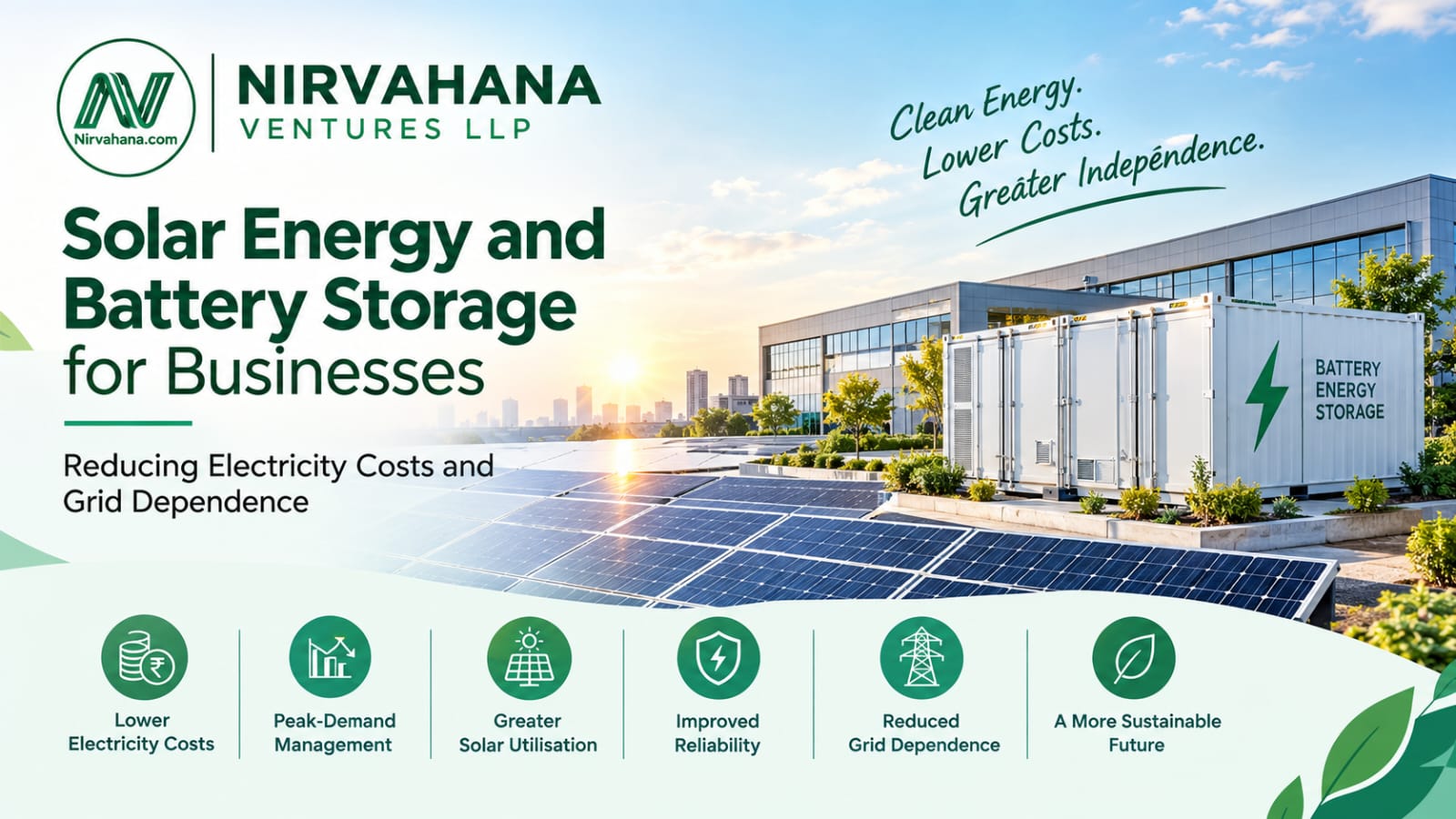
Reducing Electricity Costs and Grid Dependence
An educational article for business owners and commercial energy consumers
Introduction
In today’s competitive business environment, electricity is more than an operational necessity—it is a significant factor influencing profitability, productivity, and long-term growth. As businesses face increasing energy requirements and changing electricity tariffs, finding reliable and cost-effective energy solutions has become an important business priority.
Solar energy and Battery Energy Storage Systems (BESS) offer an opportunity to rethink how businesses generate, consume, and manage electricity. Solar panels generate electricity from sunlight, while batteries store surplus energy for use when solar generation is insufficient or electricity demand is higher.
India’s renewable energy transition reflects the growing relevance of these solutions. According to the Ministry of New and Renewable Energy, India’s installed solar capacity reached approximately 132.85 GW by November 2025. This figure should be checked against the latest official release before publication.
For businesses, the opportunity extends beyond environmental responsibility. A well-planned solar-plus-storage system can help reduce electricity expenses, improve operational continuity, and provide greater control over energy consumption.
At NIRVAHANA VENTURES LLP, the focus is on connecting clean-energy opportunities with practical business requirements through technical assessment, financial modelling, and investment-oriented project evaluation.
1. The Problems: Why Businesses Need Smarter Energy Solutions
Rising Electricity Costs
Electricity expenses can significantly affect operating margins, particularly for manufacturing facilities, hotels, shopping complexes, warehouses, and other energy-intensive businesses. Even a modest increase in electricity tariffs can translate into substantial additional expenditure over a year.
For example, a manufacturing unit operating machinery, lighting, and cooling systems throughout the day may find that electricity costs are among its most important controllable operating expenses.
High Peak-Demand Charges
Many commercial and industrial consumers pay demand-related charges based on their maximum electricity demand during a billing period. Imagine a factory where several machines start simultaneously during afternoon production hours. This temporary increase in demand may contribute to a higher monthly electricity bill.
Dependence on Grid Electricity
Businesses relying entirely on grid electricity are exposed to tariff changes, supply interruptions, and local distribution constraints. This dependence can become particularly challenging for businesses with continuous operations or limited flexibility to shift their electricity consumption.
Power Outages and Operational Disruptions
A power interruption can affect more than the electricity supply itself. A cold-storage facility may face risks to temperature-sensitive inventory; a manufacturing unit may experience production delays; a commercial building may experience disruption to essential services; and a data-dependent business may face interruptions to critical systems. The resulting costs may include lost productivity, damaged goods, restart expenses, and delayed deliveries.
Underutilisation of Solar Energy
Solar electricity is generated primarily during daylight hours, but business demand does not always follow the same pattern. A commercial building may generate excess solar electricity at midday while continuing to consume substantial electricity in the evening. Without storage, the business may be unable to use all the solar energy generated onsite at the time it is produced.
2. The Solutions: How Solar Energy and Battery Storage Work Together
Solar energy and battery storage complement each other by addressing two different aspects of energy management: electricity generation and electricity availability.
Solar Energy: Generating Electricity Onsite
Solar panels convert sunlight into electricity that businesses can consume directly. For establishments with suitable rooftops or available land, solar installations can reduce the amount of electricity purchased from the grid. A commercial building, for example, may use solar electricity to support lighting, air conditioning, office equipment, and other daytime loads.
Battery Storage: Using Energy When It Is Needed
Battery Energy Storage Systems store electricity for later use. During periods of high solar generation, surplus electricity can charge the battery. When solar generation decreases or demand rises, the battery can discharge stored electricity to support the facility.
- Morning: Solar panels begin generating electricity.
- Midday: Suitable surplus solar energy charges the battery.
- Peak hours: Stored energy supports demand and load shifting.
- Evening: Stored energy supports consumption after sunset.
Actual charging and discharge depend on system design and energy management settings.
Reducing Peak-Demand Charges
Battery storage can discharge during selected high-demand periods, reducing the electricity drawn from the grid. This process, known as peak shaving, can help businesses manage demand-related charges. The financial benefit depends on the applicable tariff, the timing of demand peaks, battery capacity, and the system’s operating strategy.
Improving Energy Independence
Solar generation combined with battery storage allows businesses to consume more of their own electricity rather than relying exclusively on grid supply. Although complete energy independence may not be practical for every facility, the combination can reduce grid dependence and improve flexibility.
Enhancing Reliability
A suitably designed battery system can support critical loads during power interruptions. For example, a business may prioritise refrigeration, emergency lighting, communication systems, or essential production equipment. Backup functionality requires appropriate electrical configuration, protection, and islanding capability; not every grid-connected solar system provides power during an outage.
3. Economic Benefits: How Businesses Can Save
The financial value of solar-plus-storage comes from several potential savings and operational benefits.
| Business objective | Potential value |
| Solar self-consumption | Reduced grid electricity purchases |
| Peak shaving | Lower demand-related charges |
| Load shifting | Better alignment of consumption with electricity tariffs |
| Battery backup | Reduced exposure to outage-related losses |
| Energy management | Improved visibility and control over consumption |
| Sustainability | Greater renewable electricity utilisation |
Understanding Time-of-Day Tariffs
India’s Ministry of Power introduced Time-of-Day tariff provisions under the Electricity (Rights of Consumers) Amendment Rules, 2023. The provisions specify lower tariffs during designated solar hours and higher tariffs during peak hours for applicable consumers. For commercial and industrial consumers, the prescribed peak-period energy tariff is at least 20% above the normal tariff, while solar-hour tariffs are at least 20% below the normal tariff, subject to applicable rules and state implementation. Confirm current state-specific tariff orders before publication or investment decisions.
This creates an economic reason for businesses to examine when they consume electricity. Solar generation, battery charging, and discharge schedules can be coordinated to respond to these price differences where the applicable tariff makes it worthwhile. Businesses should not assume that every battery installation will generate attractive savings; the economics must be established through project-specific analysis.
4. A Relatable Business Example
Consider a medium-sized manufacturing facility with rooftop solar panels. During the afternoon, the facility generates more solar electricity than it immediately requires. However, its production activities continue into the evening, when solar generation decreases.
With an appropriately designed solar-plus-battery system, solar panels can supply daytime electricity, surplus solar energy can charge the battery, stored energy can be discharged during selected evening or peak-demand periods, grid electricity purchases may decrease, and a suitably configured battery may support critical operations during outages.
The financial assessment would compare the investment and operating costs against electricity savings, demand-charge reductions, and the value of improved reliability.
The value of battery storage lies not only in how much electricity it stores, but in when and how that electricity is used.
5. Recommendations for Businesses Considering Solar + Battery Storage
- Conduct an energy audit. Review electricity bills, monthly consumption, maximum demand, and operating schedules. Where available, use hourly or 15-minute interval data to identify consumption patterns.
- Evaluate solar potential. Assess rooftop area, solar generation potential, shading, structural suitability, and electrical infrastructure.
- Identify the primary objective. Determine whether the business primarily needs lower bills, peak-demand management, greater solar self-consumption, backup power, reduced grid dependence, or a combination.
- Size the battery according to actual requirements. Battery capacity should reflect the facility’s load profile, operating duration, required discharge power, and backup needs.
- Conduct financial modelling. Include capital expenditure, operating expenditure, expected bill savings, demand-charge reductions, battery degradation, replacement or augmentation costs, financing costs, ROI, and payback period.
- Explore suitable financing structures. Depending on project requirements, businesses may evaluate direct ownership, debt financing, leasing, or energy-as-a-service models.
- Work with an experienced clean-energy partner. NIRVAHANA VENTURES LLP brings together technical evaluation, project assessment, financial modelling, and clean-energy investment considerations to help businesses assess whether solar-plus-storage aligns with operational and financial objectives.
Conclusion
Solar energy and battery storage provide businesses with an opportunity to take greater control of their electricity consumption and long-term energy strategy. Solar panels reduce dependence on grid electricity by generating power onsite, while battery storage makes that energy available when it is needed most.
Together, these technologies can help businesses reduce electricity expenses, manage peak-demand charges, improve solar energy utilisation, strengthen operational resilience, reduce grid dependence, and advance sustainability objectives.
The success of any project depends on appropriate system sizing, tariff analysis, technical feasibility, and financial viability. For businesses considering this transition, the starting point should be a clear understanding of their energy requirements and the economic value a proposed system can deliver.
NIRVAHANA VENTURES LLP supports businesses in evaluating clean-energy opportunities through practical project assessment, financial modelling, and investment-focused planning.
The future of business energy is not simply about consuming less electricity. It is about generating intelligently, storing strategically, and using energy more efficiently.