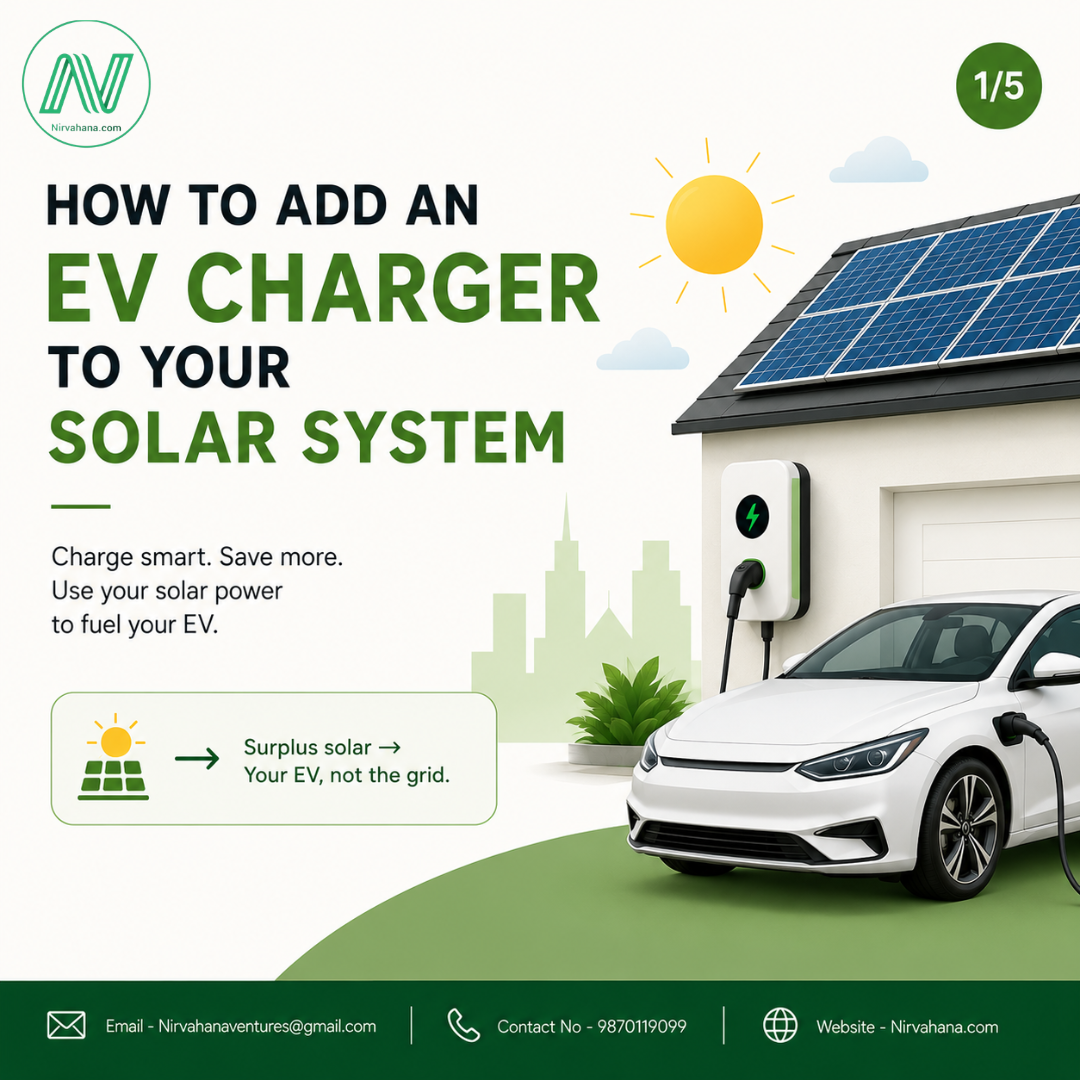
How to Add a Solar EV Charger to Your Home in India
Electric vehicles and rooftop solar complement each other naturally. Your solar panels generate electricity during the day, while your EV needs electricity for daily driving. When you connect the two intelligently, you can use more of your own solar generation instead of relying entirely on grid electricity.
For many Indian homes, a 3.3–7.4 kW AC EV charger offers a practical starting point. However, the right charger depends on your EV, electrical connection, daily driving requirements, rooftop solar capacity and home electricity demand.
This guide explains how to add an EV charger to a rooftop solar system safely and efficiently.
1. Choose the Right EV Charger
Home EV charging generally falls into two broad categories: AC charging and DC fast charging.
For most homes, an AC Level 2 charger makes more practical sense than a high-power DC charger. Common residential options include 3.3 kW and 7.4 kW chargers.
A 3.3 kW charger can suit drivers with moderate daily usage and longer overnight charging windows. A 7.4 kW charger can make more sense for households that drive more frequently or want faster home charging.
DC fast chargers deliver much higher power, but they also require more substantial electrical infrastructure and usually make more sense for commercial or public applications.
The Ministry of Power’s recent charging-infrastructure guidance also references 7.4 kW AC or DC charging for small EV charging applications.
2. Match the Charger With Your Solar System
Your solar system must support three things at the same time:
Home loads + EV charging + solar generation
For example, imagine a home with a 5 kW rooftop solar system. If the house consumes 2 kW during strong sunlight and the EV charger draws 3.3 kW, the system can potentially direct most of its solar generation toward both loads.
A 7.4 kW charger creates a larger electrical demand, so your solar system may not always generate enough power to supply the charger alone. The grid can provide the shortfall when necessary.
That does not make the charger ineffective. Instead, smart energy management can adjust charging power according to available solar generation.
The goal should not simply involve installing the largest possible charger. The goal should involve matching charging capacity with your vehicle, solar generation and daily energy consumption.
3. Plan the Wiring Correctly
EV charging creates a significant electrical load, so proper installation matters.
A typical installation should include a dedicated circuit for the charger, suitable protective devices, proper earthing and correctly sized cables. Your electrician should also consider the home’s sanctioned load, existing electrical distribution board, cable length, voltage, phase configuration and charger specifications.
Do not connect a high-power EV charger to an unsuitable household circuit simply because a socket fits.
A qualified electrician should assess the installation before commissioning the charger. The Ministry of Power maintains dedicated EV charging infrastructure guidelines and links to relevant electrical safety standards and regulations.
4. Charge When Solar Generation Peaks
This step can make the biggest difference to your solar EV charging economics.
Rooftop solar typically generates its strongest output during daylight hours. If your EV remains parked at home during those hours, you can schedule charging around solar production.
For example:
Solar panels → Home loads → EV charger → Grid receives only surplus
Instead of sending surplus solar electricity to the grid, you can direct more of that generation toward your EV.
This increases your solar self-consumption and can reduce the amount of electricity you purchase from the grid later.
Your actual savings depend on your electricity tariff, net-metering arrangement, solar generation profile and EV efficiency. Therefore, avoid treating one universal ₹/unit figure as applicable to every Indian household.
5. Understand Net Metering and Your DISCOM
Net metering can change the economics of rooftop solar because the treatment of imported and exported electricity depends on the applicable state regulations and DISCOM framework.
Under India’s Electricity (Rights of Consumers) framework, net metering measures exported rooftop solar electricity against imported electricity in kWh, while net-billing and net-feed-in arrangements can value imported and exported electricity differently. State electricity commissions determine the applicable arrangements.
This distinction matters when you add an EV charger.
Suppose your solar system generates more electricity than your home consumes during the afternoon. You can either export the surplus according to your applicable arrangement or use some of that electricity to charge your EV.
Using solar directly for your EV can provide greater value when the avoided retail electricity cost exceeds the credit you receive for exporting solar power. Your actual numbers depend on your tariff and DISCOM rules.
Before modifying your system, check the latest requirements with your DISCOM.
6. Build the System Around Your Actual Usage
A good solar + EV setup starts with your energy profile.
Consider:
- Your EV battery capacity
- Daily driving distance
- Typical charging time
- Existing rooftop solar capacity
- Daytime solar generation
- Home electricity consumption
- Sanctioned electrical load
- Single-phase or three-phase connection
- Charger power rating
- Net-metering arrangement
For example, someone who drives 30 km per day and parks at home during the afternoon may not need the same charger setup as a household with two EVs and much higher daily driving.
The right system balances solar generation, home consumption and EV charging instead of maximizing one component.
Conclusion
Adding an EV charger to rooftop solar can create a more integrated home energy system. A suitable AC charger, properly sized solar capacity, safe electrical installation and smart daytime charging can help households use more of their own solar power.
However, every home has different electrical and energy requirements. Your charger selection should account for the EV, solar system, home loads, electrical connection and applicable DISCOM rules.
Nirvahana can help you evaluate these factors and plan a solar + EV charging solution around your home’s actual energy needs.
Want to charge your EV with your own solar power? Contact Nirvahana at Nirvahanaventures@gmail.com or 9870119099, or visit Nirvahana.com.