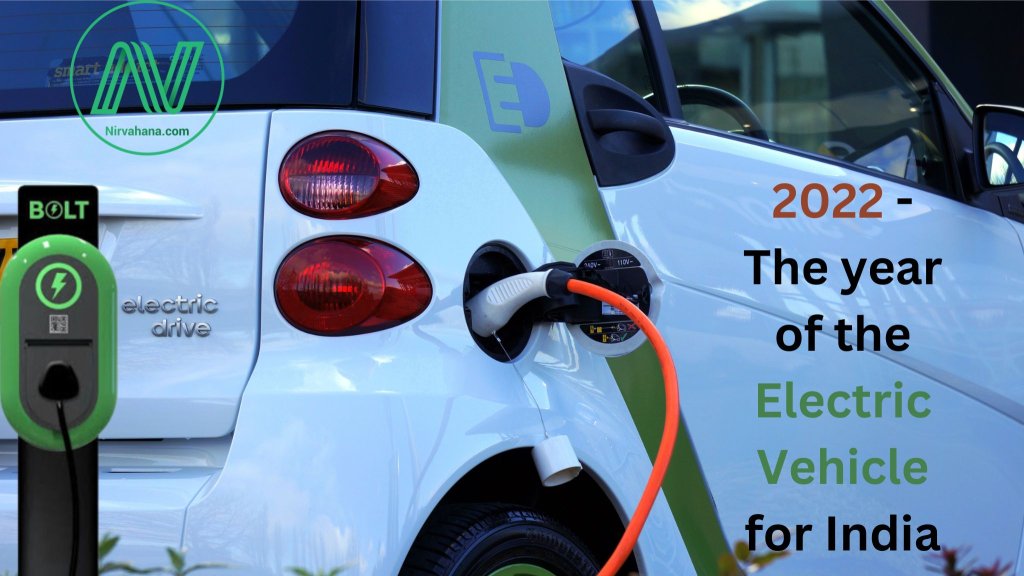
Due to the Covid pandemic, the world slowed down for a few years. We expected that the automotive industry would also take a long break as for a long time, India was on lockdown, with little movement in the market, but a lot of preparations were going on in the background to not only strengthen the economy but also make EVs more mainstream.
As the year 2022 draws to a close, we present a a study on electric vehicles, focusing on the factors that contributed to the growth of the Indian EV market in 2022.
With the new brands and segments of electric vehicles introduced in India in 2022, taking into account the growth rate of EV sales leading players such as Byd, Kia and Volvo entering the market. Volvo introduced an electric version of its XC40 crossover, while Byd and Kia started operations in the two-wheeler space with family wagons, India’s biggest player Hero Moto Corp launched an entirely new brand called Ved with two electric scooters. launched, while several new electric motorcycles were introduced. Brands and startups like Urban Matter and the most exciting one, Ultraviolet, have also emerged.
They introduced a new category with its electric sport bike F-77 inspired by fighter jets, F-77 is India’s fastest motorcycle and boasts of an Air AI certified range of over 300 kms on a single charge, but an even bigger change was the products that were made available to the public.
The Roar is the third electric motorcycle in the Indian market, the other two being the Torque Gratos and the Revolt RV, but it is not directly targeted at them. The Obin is approaching the market from a consumer perspective, hoping to compete in the lucrative 150cc premium commuter motorcycle space. The Roar not only matches the price bracket of popular 150cc motorcycles, which range between INR 1,00,000 and 1,25,000, which was quite surprising, especially since some electric vehicles comparable to 110cc scooters are touching the mark of around INR 1,50,000.
Another interesting fact is that India launched both its most expensive and least expensive electric car in 2022, as predicted. Tata launched the country’s cheapest electric car, the Thiago EV, which comes with two different battery pack options and starts from around Rs 850,000.
We recently explored the car and it serves as a strong base for mass EV adoption on the Thiago EV which comes in two forms or two battery levels, one is a 19.2 kWh battery and one is 24 kWh.
The one we’re reviewed is the 24 kWh and it provides about 55 kW of power, which equates to about 74 horsepower, and if you choose the 19.2 kWh battery, it will produce 45 kW, which is roughly 60 to 61 horsepower. In the smaller battery version, the motor makes around 110 Newton meters, and the bigger battery makes 114.
Claimed acceleration figures are just a delta figure of 4 Newton meters. Small battery does 600 bit sec, it does 500 sec You will hardly notice any difference because it is zero to 60 km time. The Tata Tiago EV hatchback is without any doubt the most affordable electric vehicle in the market at the moment.
It comes with a whiff of pressure. It has all the regular strong traits of the Tiago, it’s reasonably roomy, it’s good to see that it dries moderately well and the fact that it’s a converted car which has been converted into electric bar it has had to live with some challenges and some bargaining here and there and keeping all this in mind the way it has been done and executed by data is really very impressive, you’ll get a good enough range
And then you get a reasonably comfortable cabin. Yes, the seats could be better, and some plastic parts could be better crafted here and there, but overall, the feel is very similar to the standard Tiago. You get all the features, connectivity is great, and yes, it works great.
The most expensive of its kind performance-oriented luxury sedan, the eqs 53 AMG supercar-like performance and S-Class luxury came together for a hefty price tag of around INR 25 million, we were blown away by The Brute Electric. Motors shop and the peace and comfort of the cabin so Mercedes AMG eqs 53 what is it? It’s a gorgeously addicting car, and looks are subjective.
I’m not going there because I believe the Audi GT looks much better. It’s possibly the best looking electric car out there, but it’s extremely sleek and has a bloated feel. It also has a very good CD whereas the other tracker version costs 0.20 and then more importantly the way this thing pulls because of the power it delivers and how it delivers all those thousand plus talks that Available to you at the press of a button.
I believe that EVs, despite their lack of theatrics or drama of engine noise, are also addictive, and when you see high-end cars like this with all the power and all the technology in one solid piece of metal packs you really have to experience it to know how it feels oh another interesting product we sampled in 2022 is from BMW it easily bridges the gap between the most expensive and the cheapest
In May 2022, BMW will launch the I4, an all-electric version of its four-series Grand Coupe in India. This is a very interesting BMW, and not because of any other typical BMW trades, not because it looks good in this size and especially in this color, and not because it drives well enough. It’s interesting because of just one very important aspect, and that aspect is its price, which at Rs 70 lakh places it firmly at the more affordable end of the luxury buying experience.
So the cool thing about the BMW i4 is that it’s based on a very regular BMW 3 Series, so you get the practicality of a regular BMW 3 Series, you get the front factor of it being an electric car and the added benefit of saving the environment. Used and you get instant torque performance so you get on the throttle and understand exactly what this thing is, how it behaves like a regular car on regular roads in regular city traffic conditions and so on.
BMW claims that the operating range of this vehicle will be between 490 odd kms and 590 kms, so BMW has taken a huge margin and this is very important because range anxiety is still a big factor when it comes to electric cars. Is. And with 70 battery remaining and 300 kms of range as a range based on our calculations it fits very well.
So, if you are in cruise mode then expect around 500 kms, but if you really want to drive hell for leather, it will surely last more than 400 kms on a single charge, which is quite good . Most interesting, however, was the non-AMG version of the flagship electric Mercedes, the EQS 580. There are two reasons for this, the first being that it now has the longest range in the Indian electric car universe.
Claiming an airy approved range of over 850 kms on a single charge. Another reason is that this is the first time that an Uber luxury electric vehicle has been assembled locally in India by an international manufacturer, so expectations were high when we got behind the wheel. It excelled in quality and this helps the brand to give a tough competition to its competition in terms of pricing.
It is also a CKD model which means it is cheaper by around INR 1.55 Crore which is ridiculous considering we are used to cheap INR 1.55 Crore but anyway this is the world we live in as this is an EV Range is essentially going to be top of everyone’s mind, there is a fair amount of range, of course the ari triggers are insane but in the real world I think you’ll get an actual operating range of around 650 odd kilometers
And it’s always learning as a result of its AI systems. The rapidly growing popularity of electric vehicles, as well as their acceleration capabilities and increasing adoption, portends the same in 2022. India experienced a surge in electric mobility across various categories of vehicles and modes of transport, and the electric vehicle industry is set to receive the much-needed recognition from Indian consumers in 2022.
According to industry data from the Federation of Automobile Dealers Associations or FADA, the region saw an increase of over 686 percent in EV adoption, with over 210,000 cars, two-wheelers and commercial EV units sold between April and June. Right now, there are about 2 million registered electric vehicles in India, of which more than half are three-wheelers used for commercial transport. The second largest share is from electric two-wheelers with over 0.8 million units.
Well, the growing EV user base in India needs a better support system as well. In terms of charging infrastructure, there are around 5100 charging stations in the country and the number is increasing gradually. So, what are the big steps taken to strengthen electric mobility infrastructure in 2022?
In January, the power ministry issued revised guidelines for EV charging infrastructure, helping it set a timeline for setting up public charging stations to provide seamless connectivity. The government also emphasized on Make in India approach by tying up with local tech companies to set up charging stations.
In March 2022, the Ministry of Heavy Industry announced the setting up of 2877 charging stations in 68 cities across 25 states and union territories for faster adoption and manufacture of hybrid and electric vehicles under the second phase known as FAME programme. Another major push was not promoting battery swapping technologies to reduce recharging times for electric.
NITI Aayog released a draft Battery Swapping Policy, which addresses key regulatory, institutional and technical challenges to help India develop a battery swapping ecosystem for two and three wheelers. The Indian government focused on bringing new global players on board, but the Make in India policy remained a priority. Google, a Taiwanese electric scooter and battery swapping technology pioneer, has launched its B2B trial program in India in 2022 with Zip Electric.
FAME too was supposed to run for three years, ending on March 31, 2022, but was extended by 24 months in 2021 to March 31, 2024. The government increased the allocated budget for the fiscal year 2022–23 by $8 billion to $29 billion and $30 billion, respectively, although only 39 percent of the authorized funds had been used by November 2022.
Such central and state subsidiaries help in increasing the use of electric automobiles. Delhi Gujarat Rajasthan Chandigarh and many other states announced their revised policies and grants for EV adoption in 2022. In fact Chandigarh has set a target of 70 per cent of all new vehicle registrations being EVs in the next five years, a model of foreign policy Chandigarh plans to set itself. EV City by achieving highest penetration of zero emission vehicles
Another important step towards electrification was the unveiling of India’s first electric highway in 2022. This type of transport system would open up huge possibilities and could result in massive electrical transformation in the commercial sector. Road Transport and Highways Minister Nitin Gadkari announced the construction of India’s first electric highway between Delhi and Mumbai. During an event in March, Gadkari said his ministry’s budget is reasonable and the market is ready to sustain it. The importance of future transportation technologies cannot be underestimated.
Now our aim is to build an e-highway between Delhi and Mumbai which will work like a trolley bus. If you spend Rs 100 on fuel, LNG will cost Rs 40, CNG Rs 55, Hydrogen Green Hydrogen Rs 20 and electricity Rs 15.
Now a lot has changed and a lot of people are working on different technology not only on lithium and battery but now we can make sodium ion zinc ion steel iron battery and once I visited the Indian Oil Laboratory Research Laboratory in Faridabad then he invented this aluminum air technology and it is now the future technology for transportation
He also said that the government has received 47 proposals for laying ropeway cables in Manipur, Sikkim and Uttarakhand. We are still in the early stages of EV adoption in Himachal Pradesh and Kashmir, and a big part of the problem is concerns about vehicle range and high pricing. However, companies such as Tata and Mahindra have already invested in revolutionizing the technology, collaborating with the government to build EV infrastructure.
So, while India’s electric mobility transition still has a long way to go, there is no doubt that 2022 was an important step in that regard.
Furthermore, I wish you a very Happy New Year 2023 and advise you to be extremely careful whenever you are on the road, whether on foot or on wheels. Keep track of Charging stations and points throughout your journey in EVs using the Bolt App and be sure to install Bolt EV Charging systems to charge your vehicle safely and conveniently.
Contact Nirvahana for any EV Charging requirements.
The path to Nirvahana begins here…